

Introduction: Why Inflation Matters for Investors
Inflation is a critical economic factor that directly influences financial markets, particularly inflation stock market returns, which investors closely monitor. Changes in price levels are strongly linked to interest rates, corporate earnings, consumer behavior, and overall economic stability. When inflation rises or falls, it reshapes market expectations and determines how equities perform in both the short and long term.
Understanding the relationship between inflation and equity performance helps investors make informed decisions, manage risks, and protect real wealth. This article explains the key mechanisms, historical patterns, sector-wise effects, and practical strategies investors can use to navigate inflation-driven market conditions.
What Is Inflation and Why It Influences Equity Markets
Inflation refers to the sustained increase in the general price level of goods and services over time. As inflation rises, purchasing power declines, meaning consumers need more money to buy the same products.
When inflation accelerates:
- Business input costs rise
- Consumer spending patterns shift
- Interest rates often increase
Together, these factors explain why stock market performance changes across different inflationary phases.
Inflation Stock Market Returns Explained
Stock market returns are driven by expectations of future corporate earnings. Inflation influences these expectations in several ways:
- Higher production costs reduce profit margins
- Rising prices can weaken consumer demand
- Borrowing becomes more expensive
When inflation remains moderate, many companies can pass costs on to consumers, supporting share prices. However, excessive inflation disrupts this balance and pressures equity returns.
Interest Rates and Their Impact on Equity Returns
Central banks manage inflation primarily through interest rate policies. When price levels rise sharply, monetary authorities often increase interest rates to slow economic activity.
Higher interest rates:
- Raise corporate borrowing costs
- Reduce consumer spending
- Lower equity valuations
This is why aggressive tightening cycles often lead to weaker stock market performance, particularly for growth-oriented companies.
Moderate vs High Inflation and Market Returns
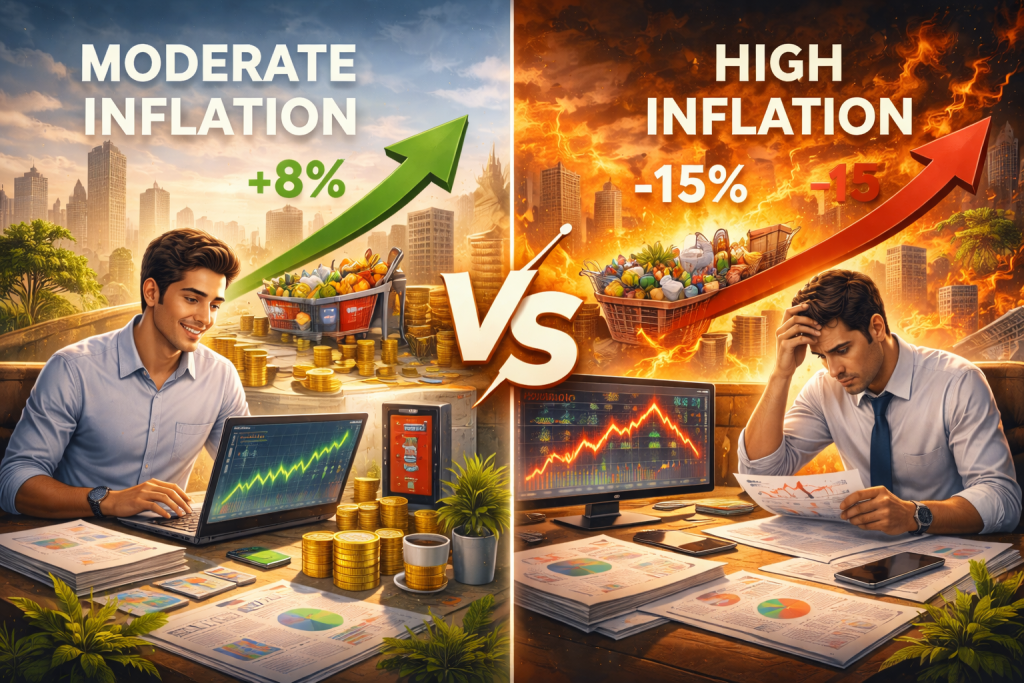
When Inflation Is Moderate
Moderate inflation is often associated with healthy economic expansion. During such periods:
- Corporate revenues tend to grow
- Employment remains stable
- Equity markets often deliver positive returns
When Inflation Becomes Excessive
High or uncontrolled inflation can:
- Reduce real household incomes
- Weaken consumer confidence
- Increase market volatility
Historically, elevated inflation has resulted in inconsistent or subdued equity performance.
Sector-Wise Impact of Inflation on Stocks
Industries That Tend to Perform Well
Certain sectors are better positioned during inflationary periods:
- Energy and commodities
- Consumer staples
- Real estate
These industries often have pricing power that helps protect profitability.
Industries That Face Pressure
Other sectors may struggle, including:
- Technology stocks
- Utilities
- Highly leveraged companies
Rising interest rates and valuation compression can weigh heavily on their returns.
Corporate Earnings, Pricing Power, and Stock Returns
Corporate earnings are a key driver of stock prices. Inflation affects earnings through:
- Higher labor and raw material costs
- Supply chain disruptions
- Shifts in consumer demand
Companies with strong brands or pricing flexibility are better able to maintain margins during inflationary environments.
Inflation Expectations and Stock Market Behavior
Markets are forward-looking by nature. Often, it is not actual inflation but expected inflation that moves stock prices.
When inflation expectations rise:
- Market volatility increases
- Defensive stocks attract attention
- Risk appetite declines
Investor psychology therefore plays a major role in shaping short-term market movements.
Real vs Nominal Stock Market Returns
Nominal returns represent headline gains, while real returns adjust for inflation.
For example:
- 12% nominal return
- 8% inflation
- Only 4% real return
This erosion of purchasing power highlights why investors must assess returns in real terms during inflationary periods.
Dividend Stocks as a Hedge Against Inflation
Dividend-paying stocks can help offset inflation, but only if payouts grow over time.
- Rising dividends help preserve purchasing power
- Fixed dividends lose real value
- High-quality dividend stocks often perform better during moderate inflation
Dividend growth strategies can improve portfolio resilience.
Asset Allocation Strategies for Inflationary Markets
Effective asset allocation becomes increasingly important when inflation rises.
Inflation-resistant assets often include:
- Equities with strong pricing power
- Inflation-linked bonds
- Commodities
- Real estate
Diversification helps stabilize portfolio performance across market cycles.
Historical Relationship Between Inflation and Equity Markets
History shows mixed outcomes:
- Moderate inflation has often supported equity growth
- High inflation has increased volatility
- Disinflationary phases have boosted valuations
These patterns confirm that market outcomes depend on inflation levels and policy responses.
Long-Term Stock Market Performance During Inflation
Over long periods, equities have generally outpaced inflation despite short-term fluctuations.
Key drivers include:
- Earnings growth
- Compounding returns
- Economic expansion
Disciplined long-term investors are better positioned to overcome inflation-related volatility.
Global View: Inflation Across Markets
Inflation impacts regions differently:
- Emerging markets often face higher inflation volatility
- Currency depreciation can amplify inflation effects
- Global diversification helps manage risk
Understanding global trends improves portfolio balance.
Practical Investment Strategies During Inflation
Investors can manage inflation risk by:
- Focusing on financially strong companies
- Limiting excessive leverage
- Maintaining diversification
- Avoiding emotional decisions
A disciplined approach supports more stable outcomes during uncertain periods.
Conclusion: Managing Inflation Stock Market Returns
Inflation is unavoidable, but its impact on equities can be managed. From interest rates and earnings to investor behavior and sector performance, inflation stock market returns are shaped by multiple interconnected forces.
By understanding inflation dynamics, applying thoughtful asset allocation, and maintaining a long-term perspective, investors can protect real wealth and achieve sustainable returns even during inflationary cycles.